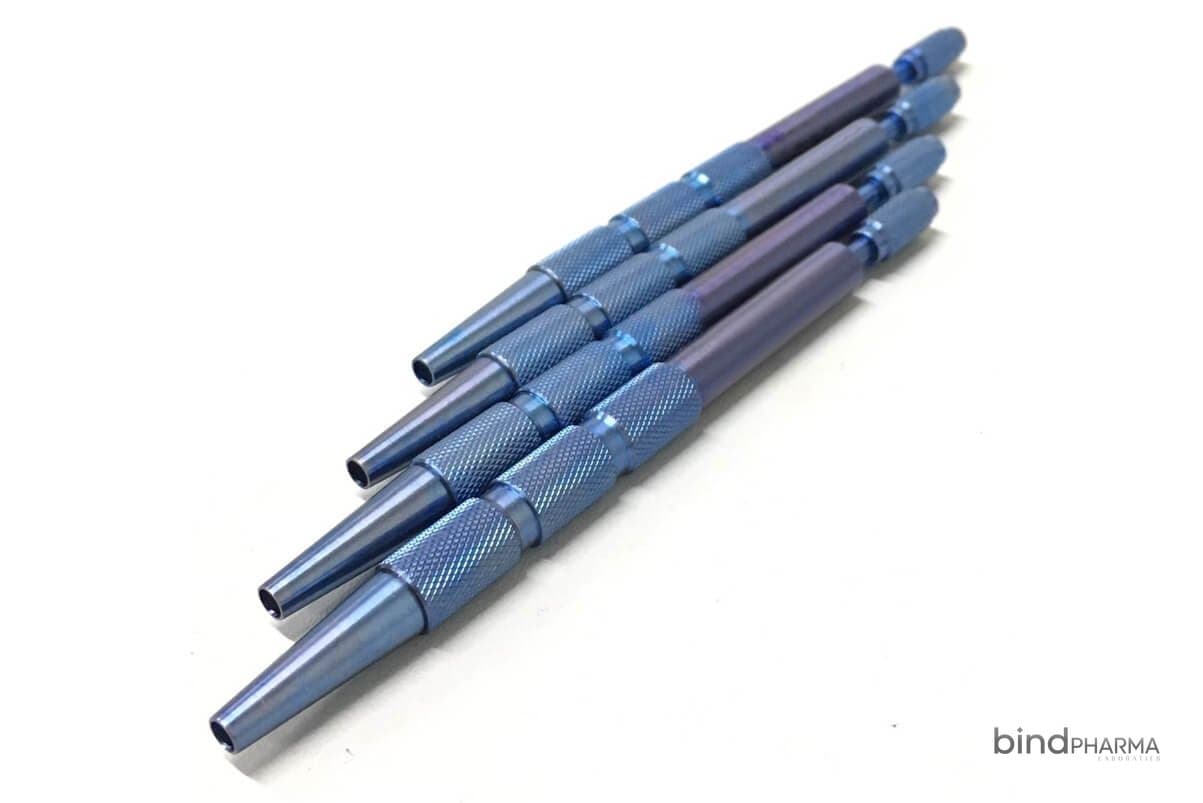
Punch diameter is the most consequential setting in follicular unit extraction. Too small and you slice follicles; too large and you scar the donor zone. The art is matching the FUE punch diameter to the patient in front of you rather than defaulting to a single size for every case.
What diameter actually controls
Every increase in diameter does two opposing things. It gives the follicular unit more clearance, lowering transection risk, and it enlarges the donor wound, raising the eventual scarring and slowing healing. The correct diameter is the smallest one that reliably releases the graft intact for that patient.
That means there is no universal best size. The right answer depends on hair caliber, how many hairs sit in each follicular unit, follicle curl, and how forgiving the patient's skin is.
Read the hair caliber first
Caliber is the thickness of the individual hair shaft, and it is the starting point for sizing:
- Fine hair releases through smaller wounds. Surgeons often work at 0.7 mm to 0.8 mm.
- Medium hair sits comfortably around 0.8 mm to 0.9 mm for most scalp work.
- Coarse hair frequently needs 0.9 mm to 1.0 mm so the thick shaft and bulb are not clipped.
These are starting points, not rules. The decisive test is always a small trial extraction at the chosen size.
Account for follicular unit size
A follicular unit can hold one to four hairs, and multi-hair units are physically wider than singles. A diameter that cleanly extracts single-hair units may transect the outer follicles of a four-hair unit.
Surgeons who plan to harvest large multi-hair units for the mid-scalp and crown often size up slightly, then use smaller singles, harvested with a smaller punch, for the hairline where a natural, fine result matters.
Curl and ethnicity shift the numbers
Tightly curled and Afro-textured hair curves beneath the skin and usually needs a larger diameter, often 0.9 mm to 1.0 mm, plus a serrated edge, to avoid chasing the bulb around its bend. Straight Asian hair tends to be coarse and individually thick, also pushing diameter up. Fine Caucasian hair frequently allows the smallest sizes. Knowing your patient population helps you stock the right range.
The scarring trade-off in numbers
Donor wound size scales with diameter, and the visible result compounds across thousands of extractions. Dropping from 1.0 mm to 0.8 mm meaningfully reduces the open wound area per graft, which is why surgeons push for the smallest viable size, especially for patients who wear their hair short. The constraint is transection: shrink the punch past what the follicle needs and graft survival falls.
Test, do not guess
The professional workflow is simple and repeatable:
- Start with a size suggested by caliber and unit type.
- Extract a small batch and inspect grafts under magnification for transection.
- Adjust up or down until you find the smallest diameter with acceptable yield.
- Re-test if you change donor zones, since caliber varies across the scalp, beard and body.
Why edge quality changes the calculation
Sizing assumes a sharp, true-to-spec edge. A dull punch behaves like a larger, blunter instrument: it tears, deforms the wound and forces deeper scoring, so a nominal 0.8 mm punch can scar and transect like something cruder. A punch that holds a sharp, accurate edge lets you confidently use the smallest viable diameter. This is why edge consistency and true diameter tolerance, not just the printed size, are what you are really buying.
Our FUE punches are made to tight diameter tolerance with some of the sharpest edges on the market, so the size on the label is the size that meets the skin, batch after batch.
Stocking a sensible range
No clinic should run on one diameter. A practical wholesale order covers 0.7 mm, 0.8 mm, 0.9 mm and 1.0 mm so the surgeon can match the patient rather than the inventory. Distributors should carry the full ladder so their clinic customers never have to compromise on size.
Want to dial in the right diameters for your caseload? Request a free sample set across our diameter range, or ask us for a wholesale quote to stock the full ladder.